Wednesday, July 21, 2010

EOC: Excercise Ch. 2

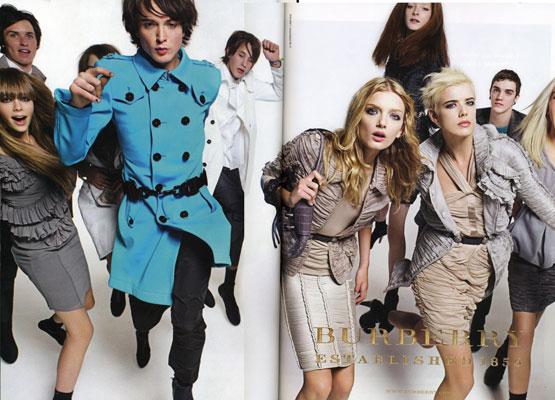
Trace the history of the fashion brand Burberry. Examine its ads today and those from past campaigns. What are the differences? Has the target market changed? Did this fashion company follow its target market clients as they aged? Back up your research with clear examples.


Burberry was founded in 1856. The man behind the brand was called Thomas Burberry. He was English and therefore lived in England. He opened his first store in Basingstoke (England).

In 1860 the brand (known as Burberry) became very well known and in some cases even called an “emporium”. Burberry focused on outdoor wear, often for local residents. But also for sportsmen, the brand Burberry was at the time popular among sportsmen, although today the brand is known and seen in a different way. The owner back then was of course Thomas Burberry. But today it’s far more complicated than that. There’s not just one person being the owner, there isn’t even two, it’s actually different companies that own their own part of the brand. The majority owner of Burberry is GUS (Great Universal Stores). It’s a British company that also owns the Argos stores.

Since the beginning of the new millennium “no drastic changes have occurred.” New stores have opened around the world, new fragrances are often released by the brand and it has a much wider collection, although they are still trying to keep that old typical English style.

“London-based Burberry is plugging its typically stylish fall/winter 2010 collection with a new digital campaign that's centered on a new website where visitors can use their mouse to manipulate several images and videos featuring Blue Steel-faced models and their new Burberry gear.”

In a statement, Burberry's chief creative officer Christopher Bailey describes the campaign like this:
"This campaign protects our authentic and timeless heritage and evolves the modern way in which we communicate that. The Burberry campaigns have always been characterized by the dynamic British cast and I wanted to express the individuality and the energy behind each of their different creative expressions. Burberry was founded on innovation and outerwear and I want anyone who sees the campaign not just to see images, but to feel a part of what we have created; connecting people through technology, music, the collections, the attitude, and the emotion captured."

EOC: Discussion Questions Ch.2

1.How has fashion advertising changed since the mid-twentieth century? What are some of the differences between ads that appeared before the 1950’s and those from the 1950’s, 1960’s and today?

Fashions ads have drastically changed from that of the 1950’s. The ads which I have seen from the 1950’s are subtle and make you dig deeper into the story of the ad then how it is now which it’s mostly right up in your face. They had hints in their ads that helped you relate to those ads, but today it’s mostly sex, sex, and more sex! Sex sells and they did use it back in the 1950’s but not how graphic it is today. Today everything is more out in the open where as back in the 1950’s you had to watch what was said or what you watched the television or heard on the radio, it’s just how the times were back then. It has evolved into a open environment in my opinion and some ads are way too open.

2.What are some of the theories related to fashion branding (i.e., Barthes and Baudrillard)? What do they say about fashion branding as a means of communicating with consumers? How do the contemporary ideas of Hamilton, DeBord, Agins, Gobe, and McCracken relate to those of Barthes and Baudrillard?

Roland Barthes said “clothing garments are created and stylized in the design process to suit current fashion. “ He believed that a garment is actually present in fashion system at three distinct levels: the real garment; the terminological garment; and the rhetorical written garment.
Jean Baudrillard theory was hyperreality. This meant hyperreality presents itself to consumer through media. He believed that brands are the principle concepts of advertising culture, and that they constitute a new discourse in the order of consumption. I think the modern views that are shown today derive from what Barthes and Baudrillard said but we have now taken it and dug deeper to grab onto the root of branding and how it does connect to the consumer.

3.What types of meanings does Grant McCracken associate with fashion products? Do you agree or disagree? If you disagree, what would you add to or delete from his list? Give an example of one of the meanings.

Grant McCracken identifies nine different types of meaning that are usually targeted by companies: gender, lifestyle, decade, age, class and status, occupation, time and place, value and fad, fashion and trend meanings. These meanings are determined by the company, its competitors, customers, marketing segmentation, product and service, positioning, market mix, and price of each consumer item. I agree with McCracken. I believe we do associate ourselves with the brand by those meanings or they brand us by those meanings.

Tuesday, July 20, 2010

EOC: Exercise Ch. 1

Find a fashion advertisement. Identify any historical, social, or cultural icons in the ad and share the story the ad is trying to tell the viewers. How does this ad make the consumer want to purchase the product?


This ad by SISLEY is disturbing yet intriguing. It tells me that fashion is like a drug and it’s hard to withdraw from it. It is controversial in the way that the dress is appeared to be made out of cocaine, but fashion is art and art is meant to grab you and pull you in. This ad pulls me directly in and makes me contemplate what it is I am really looking at. This ad also is telling me look at this dress and these models they live and breathe fashion and love to shop. They will do whatever to keep their hands on it or be a part of the industry in some way. I love that intensity. It shows a passion for this art and a love for this brand.

This ad I feel makes the consumer want to go to the SISLEY store or website to look around even if they don’t purchase anything. Their ads make the consumer want to discover more about this brand. It made me look at their website. I wanted to see if they had any more outrageous ads and I wanted to see what type or merchandise they have. Ads that make you curious are the ones who grab you and pull you straight into the door. It’s a great tool because we are all human and are very curious beings.

One thing is for sure, with fashion you can turn into a junkie but hopefully the junkie that buys tons of clothes and accessory (hoarder) not a coke head as portrayed by the model on the right. She freaks me out and makes me turn a away from the ad in horror of how realistic she looks and I fear if I look at this brand anymore I may become the models twin. But you got to love the realism portrayed in this ad and the attention to grab the consumer in and keep them in for a good few minutes to try and see what the hell this ad is supposed to depict.

EOC: Discussion Questions Ch. 1

1.What is fashion branding? How does branding establish a product’s identity?

Fashion branding which has been described in the book as “The cumulative image of a product or service that consumers quickly associate with a particular brand, it offers an overall experience that is unique, different, special and identifiable.”(Brand Story, Joseph Hancock, pg 4) Fashion branding also creates an identity for that company and the consumers. It carries the vision from the developer to the ending point which is the consumer. For me branding is what surrounds the product/garment. It incorporates the image that retailers, designers, marketers, etc. have created that conveys a message to the consumer to go buy that brand.

2.How are companies able to sell items like T-shirts, jeans, and sunglasses at high prices? Can you give an example of another item sold in luxury market that might not have been traditionally perceived as a luxury good?

Companies are able to sell jeans, t-shirts, and sunglasses at high prices for the mere fact they have put their logo on that product. That logo ha branded that item and has conveyed the image of a luxury item and with that name the consumers automatically think of the fine detail and exquisite materials used to produce the product. Therefore it seems normal to have a pair of high price sunglasses. I would have never thought of a pen from a luxury retailer or underwear to be considered “high end” and worth $75, however with the logo imprinted on these items they have now been branded and have a invisible guarantee that this will be worth the money and won’t fade, break, run out to easily. It’s a product that will last.

3.Race, ethnicity, religion, and sexual orientation play a part in purchasing decisions. Identify three consumer groups that are different from you. In your opinion, do they differ from each other with regard to fashions and the types of brands they purchase? Why or why not?

Three Consumer Groups: Asians; Mormons; Lesbians
We all differ in our purchasing decisions. Some ethnicities tend to buy one brand more than another and never want to change from that brand. Others may have a strict religious background and they can only shop in certain stores that carry certain brands. That’s what makes fashion so amazing is that it can bring all different types of people together even if its liking of an accessory or a certain brand. It gives people a voice they may not be comfortable expressing verbally so they express it through items they have purchased.

Wednesday, July 14, 2010

BOC: Slip! Slop! Slap!


Slip! Slop! Slap!

Slip on a shirt, slop on sunscreen and slap on a hat. This slogan is to make us more aware of skin cancer and how it can occur in any age or gender. “Remember, make your motto, “slip, slap, slop” this summer. Your skin is the largest organ you have. Protect it with prevention.”[1]Its summer time and me of all people love to baste myself in the sun while lounging in the pool. I would prefer a hot cabana boy as well to bring me drinks but I would settle for a floating cooler with a picture of a gorgeous man on it.

“Obviously the best way to avoid skin cancer would be to stay out of the sun all together, but that would be completely impractical for most people and not much fun at all!”[2] I fully agree with this statement. Yes it is safer to stay out of the sun but then you miss out on the boat trips, swimming in the ocean, going to water parks. I mean who doesn’t like water parks? But we do need to be aware that if we play with fire we may get burned so we need to prepare ourselves for any case scenario. Always wear sunscreen, never just bake because instead of a being a bronze filled glowing sunflower you look like Larry the lobster and that’s not cute.

“The Slip! Slap! Slop! mnemonic, first promoted jointly by the Canadian Cancer Society and the Canadian Dermatology Association, is sensible and easy to remember.”[3] With this slogan it can definitely heighten people’s awareness but does not force them into a panic frenzy of never wanting to go outside. I think this slogan will be around for a while and who knows they may keep adding to the slogan.


[3] http://www.aboutkidshealth.ca/News/Slip-Slap-Slop-The-happy-sounds-of-summer.aspx?articleID=8209&categoryID=news-poh2